|
COMBAT
The world of SSKiller is supposed to be a fun one, and nothing
tends to be more fun than killing something in a very nasty way.
Oh dear that sounds awful. Oh well so what, its true.
Combat in SSKiller is simple, because its simple its fast, all
you need to know are the basics and a few rules to make the more
complex situations a little simpler and your away. Here we go
then.
The Initiative: some games swear by initiative,
rolling each round, re seating the players to conform to there
initiative order, and so on, in SSKiller the initiative is gained
by the first person to call a combat action and then follows in
any easy way the GM wants, I prefer random seating order, what I
mean by that is whoever is sat on the right hand side of the
person with initiative, following through to the right until all
participants have acted, at which time its the end of the round
and the start of the next, this method seems to work fine.
Combat Action: a combat action is any action
called for in a combat, well what did you think it was? They
range from making an attack, through to watching something to
find out the outcome.
The Attack: a player declares he wants to attack
something, the GM tells him to roll, also the GM may tell him any
modifiers, see Table 3.1 the player then rolls his skill check.
Eg. Treebow wants to attack the Troll bouncer ‘Olg’ and
so makes an attack roll with his Hafted as he is using his Priest
Hack.
Attack success: on a successful attack roll the
player then rolls 3D the GM then asks the player for his attack
row, the GM then cross references the players roll with his
attack row, modifying the row for any Armour, or special
abilities used etc., See damage row modifiers Table 3.2 the
result is explained below
Eg. Treebow succeeds his hafted roll and then rolls an 11 for
damage, Treebow is using a Priest Hack Attack Row 12. The GM then
consults the Damage Table 3.0 normally a ‘I’ result but
the troll gains a -3 row modification for it’s thick stone
hide so shifting down three rows to row 9 we find the result the
result is a ‘W’ Wound result.
|
| 3 |
4 |
5 |
6 |
7 |
8 |
9 |
10 |
11 |
12 |
13 |
14 |
15 |
16 |
17 |
18 |
| N |
N |
S |
S |
S |
W |
W |
W |
W |
I |
I |
I |
I |
K |
K |
K |
| N |
S |
S |
S |
W |
W |
W |
W |
I |
I |
I |
I |
K |
K |
K |
K |
| N |
S |
S |
W |
W |
W |
W |
W |
I |
I |
I |
I |
K |
K |
K |
K |
| S |
S |
S |
W |
W |
W |
W |
I |
I |
I |
I |
K |
K |
K |
K |
K |
|
Treebow hacks at the troll, his Priest hack bounces of
Olg’s thick stony hide only wounding him.
Attack Exceptional Success: an exceptional
success bypasses any row modifiers.
Eg. As in the above example Treebow attacks Olg, but because of
his exceptional success the priest hack’s damage column
remains a 12.
Treebow hacks at the troll, his Priest hack finds a weak point in
Olg’s stony hide Incapacitating him.
Attack Failure: you miss
Treebow swings wide of the mark, Olg grins at him menacingly.
Attack Exceptional Failure: an exceptional
attack failure can mean anything the GM’s twisted mind can
think up. The result should rarely be fatal, but sometimes are.
Eg. Treebow swings at Olg the Troll, missing, losing grip on his
Priest Hack and sending it spiraling through the air towards Melf
his Goblin ally. Treebow then makes a thrown attack on Melf, and
if successful could kill the unlucky Goblin.
Treebow swings at Olg the Troll, missing Olg but burying his
Priest Hack in the trunk of a nearby tree, his Priest hack is
stuck! Oh dear what now?
Treebow swings at Olg the Troll, and momentarily looses grip
on his Priest Hack, juggling the axe for a while it finally comes
down on his head, Treebow must make an attack roll on himself.
Bet he wishes he wasn’t so good with hafted now!
Damage Results: there are six damage results as
explained below. Damage is cumulative except stuns, that is two
Wounds equal an Incapacitate, two Incapacitates equal a Kill.
N = No damage, the blow was weak and
ineffectual, although it hit and is still classed as a successful
attack the blow dose no damage.
S = Stun, the blow smashes into the target,
although no serious damage is done, the target is stunned and can
do nothing but run away at half movement until the stun has gone.
W = Wound, the blow causes a nasty wound to the
target.
I = Incapacitate, the blow is a good one
smashing into the target and incapacitation it.
K = Kill, a killing blow.
D = Destroyed, the blow is powerful enough to liquefy bone and shatter stone, Wow, what a guy.
The difference between Monsters and Hero’s.
In SSKiller there is a notable difference between Monsters
(anything from a fly through to the most powerful Dragon) and a
Hero, usually player characters but on occasion not. The main
deference is a monster is affected by the Damage result as
stated.
Eg. ’Olg’ the Troll is a monster, an Incapacitate or
Kill result will do just that, Incapacitate or kill him.
‘Treebow’ is a Hero, you must find where the blow hits,
so an Incapacitate result, depending on where it hits (roll 3D on
your character sheet hit location) may incapacitate one of his
Arms or Legs, or may cause him to Fall unconscious from a head or
body hit. See Hero Damage Below.
Also Hero’s may have Ring of None Lives, the players have no
way of knowing if this Orc is a monster or a Hero until they
start fighting it. Non player Hero’s should be rare and not
every creature a party meets, one every other adventure, not
gaming session should be often enough. But sometimes throw in a
couple at once just to keep the players on edge.
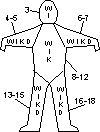
Hero Damage: yes unfortunately Hero’s get
hurt. Whenever a Hero receives a Wound or above, roll 3D on the
player character damage location chart on the player character
sheet.
The numbers represent hit locations. The letters a
damage Result.
Note. Some locations do not have damage results these
locations Cannot take that damage result and still have
the Hero survive.
Eg. You can’t take a Kill or Destroy to the head and
live or take a Destroy to the Torso and survive.
An Incapacitate to the Head or Torso will Incapacitate
the Hero as will a Kill to the Torso.
An Incapacitate or Kill to the Arms or Legs will render
them unusable. A destroyed result to the arms or legs
will sever them from the body. Wounds are still
cumulative to a Hero but only in that location.
If a Hero Is hit in a location he no longer has due to a
Destroyed result no further damage is taken from that
result.
|
 |
Armour reduces the Damage Row of a given
attack, many creatures have armour of some sort, armour rows are
non cumulative, you can’t wear two types of armour at the
same time and gain both protections. (You can’t wear Plate
Mail & Chain Mail to gain an Armour Row of 5. It takes the
highest Armour level for your Armour. In this case 3.)
Other Actions in Combat: a combat not only
consists of one thing hitting another, it also consists of all
manner of events, usually while one things hitting another.
Running Away. This is some peoples favored
combat action, and lets face it, you want to live at some point
you’ll find yourself running away from something. A
character can run in any given round up to about 30 feet. If he
want’s to do something else as well he can ether half this
to 15 feet or take his action at a half skill level. This
represents him being occupied with not falling flat on his face.
Characters with the Running Hero Skill may double this normal
movement to 60 & 30 respectively.
Casting Spells or Using Powers
during a combat, Offensively, Defensively or otherwise is quite
common by house who can. As usual the player states the Spell,
Power or Effect they desire, the GM assigns a difficult based on
others of its type, (Note Spells & Powers that do not use the
casters hands are more difficult or do less effect) the player
rolls a skill check on his appropriate skill, and the results are
explained to the player.
Using Hero Powers is also quite common in
combat, and follows the usual rules noted in the Hero Skills
section.
A Complex Action may be performed given the
correct circumstances, most of the time no penalty will be
incurred for performing these types of action, except when they
affect other attackers.
Eg.1. Treebow using his Hero Skill Run (running 30 feet), wants
to run past a Kobold Warrior, attacking it with his axe and run
past it out of the door to escape. The GM rules that this is a
possible complex action but the Kobold will get a return attack
on Treebow before he gets past (If the Kobold survives the attack
that is.)
Eg.2. Falin the Street fighting Mage Passed, wants to perform a
complex action using his Hero Skills, Unarmed Attack and Spells
as such, Falin attacks the Dragon with his Fists, he states if
successful he’ll be using both a Hero Skill and a Spell, the
GM notes this is OK as he has all three, Falin rolls his Unarmed
Attack succeeding, Falin then attempts to do a Dragon Punch Hero
Skill, he may succeed or Fail, the spell he wishes to use is the
Power Punch the only requirement is a successful unarmed attack
is made, it was.
As you can see some actions may be quite complex and as in the
case of Falin above if successful quite devastating (well maybe
not against a Dragon.)
A Waiting Action is an action that depends on
another action taking place. IE. Treebow wants to wait outside
this door to see if any Kobolds stick there heads out, if they do
he wants to try and cut there heads off. The Action is a standard
attack, but is depending of a Kobold being curious and sticking
its head out of the door to see what all the shouting is about, a
waiting action may never happen, or may be canceled by the player
saying he wants to do something else. Waiting actions happen
Immediately the circumstances are met and may only be averted by
a successful Hero Skill.
Surprise, sometimes players or monsters may be
surprised by circumstances, IE. a Kobold hearing someone shouting
outside a door may not be surprised to find an adventurer party
waiting outside for him, but a Kobold settling down to sleep will
probably be surprised when three Adventurers jump out of his
bedding in which they’ve been hidden for the last four
hours. The affects of surprise are identical to a Stun damage
result that lasts for one round.
Modifiers, in combat are all totaled first, IE a
Half, a Half and a Double, is just a Half as the other Half and
Double cancel out, once all modifiers have been worked in this
way the skill is then calculated.
Eg. Treebow is attacking a TreeEnt with his War Axe, his weapon
arm is wounded and his Body's Wounded . He swings, his normal
skill with hafted is 11, modified to 9 because of his wounded arm
then halved to 4.5 rounded up to 5. Always round up for
everything. If the Target was stunned you wouldn’t have
Doubled the 5, you just cancel out the original Half.
Subdue, sometimes you don't want to kill the
thing your hitting, you just want to subdue it, or knock it out,
if you call that your pulling your blows,
subduing or just say your not trying to kill the thing, your
blows will only do temporary damage, the damage will ware off
after a few minutes, so a Kill result will knock the opponent
down and after a few minutes the Kill will become an incapacitate, the incapacitate
in a few minutes will become a
wound etc.
|
|


